
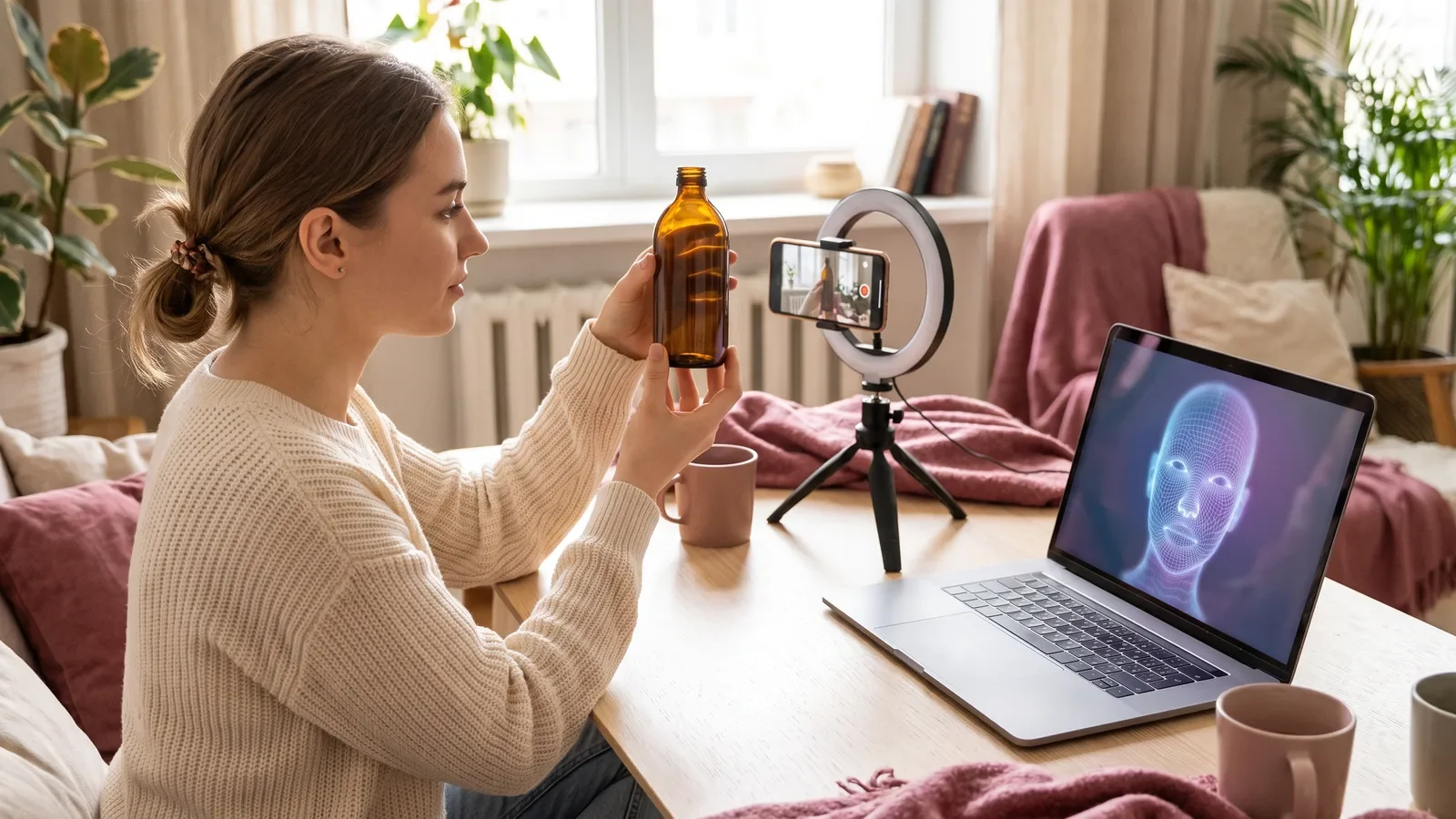
Search "AI UGC" and most of the first page is software vendors selling the same promise: a talking-head video from an avatar, in minutes, for a fraction of what a creator charges. Some of that is true. AI avatars are fast and they never miss a deadline. What the landing pages skip is where those videos stop working: when a viewer needs to believe a real person used the product, when a platform puts an "AI info" label on your ad, and when EU transparency rules apply to your campaign.
We should declare our interest. ScoutBerry is a network of human UGC creators, so we are not neutral on this question. That is also why this guide sticks to primary sources, each with a date, and says plainly where AI is the better tool.
What people mean by "AI UGC"
The label covers four quite different things, and the rules treat them differently:
- Stock avatars. A library of digital presenters, usually built from real actors (the "UGC actors" many tools advertise) who licensed their face and voice. You pick a face, paste a script, export a video.
- Custom avatars or "digital twins". A clone of a specific person, made from their own footage with their consent.
- Fully generated video. Scenes, hands, products and people produced from a text or image prompt.
- AI-edited real footage. A real creator's video with AI dubbing, lip-sync, background swaps or extra generated shots.
The first three are what most "AI UGC ads" tools sell. The fourth is where human and AI production already overlap, and where contracts matter most.
Where AI UGC does a good job
There are jobs where an avatar is the sensible choice, and pretending otherwise would be bad advice:
- Testing hooks and scripts before a shoot. Ten versions of an opening line, rendered in an afternoon, will tell you which angles deserve a real production budget.
- Internal concepts and storyboards. Showing a client or a founder what a UGC ad could look like before anyone is booked.
- Explainers where nobody is vouching for the product. Onboarding videos, help-centre clips and FAQ answers, where the presenter is a narrator and not a customer.
- Fast variants of an approved message. New aspect ratios, shorter cuts and on-screen text swaps, when the claim itself has already been cleared.
What these jobs share: the viewer does not need to believe that a real person tried the product, and the output rarely reaches paid placements with a face on it.
Where it breaks down
Trust: consumers are less impressed than marketers think
The IAB and Sonata Insights study "The AI Ad Gap Widens" (published 15 January 2026, 505 Gen Z and Millennial consumers and 104 ad executives, US) found that 82% of executives think young consumers feel positive about AI-generated ads. Only 45% of consumers actually do. The gap grew to 37 points, from 32 in the 2024 edition. Consumers were also twice as likely as executives to call brands that use AI for ads "manipulative" (20% vs 10%) and "unethical" (16% vs 7%).
Kantar reports the same pattern: in its Media Reactions 2024 study, 41% of consumers said AI-generated ads bother them, compared with 29% of marketers (Kantar, November 2025).
The IAB research also has a more hopeful finding. 73% of the consumers surveyed said that knowing an ad was made with AI would increase their purchase likelihood or make no difference, and more than half want disclosure when an ad uses AI video or AI images (IAB, January 2026). These are stated intentions from a US sample of young adults, not measured sales. Still, IAB's own reading is that disclosure "has more upside than downside" with Gen Z and Millennial audiences. The bigger risk is hiding the AI, or using an avatar to pose as a customer.
Platform labels you don't control
Meta requires people to use its disclosure tool when they post organic content with photorealistic video or realistic-sounding audio that was digitally created or altered, and says it may apply penalties if they don't (Meta, 6 February 2024). On ads, Meta labels creatives made or significantly edited with its own generative tools. When the result includes an AI-generated photorealistic human, the "AI info" label sits next to "Sponsored". That placement applies to Meta's own tools. For ads made with third-party AI tools, which is how most avatar UGC is produced, an update of 1 June 2026 says Meta will start detecting them automatically through industry-standard signals and will show the "AI info" label inside "About this ad", a new panel in the three-dot menu that Meta is now rolling out (Meta, February 2025, updated June 2026).
TikTok requires creators to label all AI-generated content that contains realistic images, audio or video, and can apply an "AI-generated" label automatically when a file carries C2PA Content Credentials. Once applied, the creator cannot remove that label (TikTok Help Center). Videos made with TikTok's own Symphony Creative Studio, avatar videos included, are labelled "AI-generated" (TikTok for Business, June 2026).
So the "nobody will notice" argument is getting weaker on both platforms. Metadata travels with many generated files, and the label may be added whether you planned for it or not.
The EU AI Act: Article 50 applies from 2 August 2026
Article 50 of the AI Act sets transparency duties. Providers of generative tools must mark their output in a machine-readable way. Deployers, which includes a brand using such a tool for its advertising, must disclose when image, audio or video content is a deepfake: content that resembles existing persons, objects, places or events and would falsely appear authentic. The European Commission's FAQ specifies that "existing" also covers people who could plausibly exist, so a photorealistic avatar of an invented person is not automatically outside the rule. The same FAQ makes three more points that matter for marketing teams:
- The rules apply from 2 August 2026. The only grace period, until 2 December 2026, covers the machine-readable marking of tools already on the market, not the deployer's disclosure.
- A company stays the deployer even when freelancers or contractors operate the tool on its behalf.
- The disclosure must be clear at the first exposure at the latest, and the invisible watermark alone is not enough. Fines can reach €15 million or 3% of worldwide turnover.
Source: European Commission, Article 50 FAQ, last updated 24 July 2026. Whether a given avatar ad counts as a deepfake depends on how realistic it is and on what the audience expects, so check with your legal team before a campaign. This article is not legal advice.
The UK: no blanket rule, same old standards
The UK has no general legal requirement to disclose AI in ads, according to the Committee of Advertising Practice. The CAP and BCAP Codes have no AI-specific rules, but they apply however an ad was produced. CAP suggests two questions: would the audience be misled if the AI weren't disclosed, and does the disclosure clarify the message or contradict it (ASA/CAP, 29 May 2025).
The testimonial problem
This is where AI UGC gets risky in any market. A UGC script usually says "I tried this" or "my skin felt different after a week". An avatar never tried anything. Put those words in a synthetic mouth and you have a testimonial from someone who doesn't exist. No label fixes that. If the format depends on a person vouching for the product, you need a person who actually used it.
Rights and likeness: whose face is it?
Stock avatars are built from real people, and their contracts don't always match how brands use them. In April 2025 AFP reported on actors who had licensed their likeness to AI avatar companies and later found their digital clones promoting dubious health remedies, with contracts that stopped them getting the videos removed (AFP via GMA News, 16 April 2025). That is reputational exposure for any brand whose ad uses the same face.
Vendor terms also limit paid use. Synthesia's Acceptable Use Policy, for example, prohibits using a stock avatar in "promoted", "boosted" or "paid" social advertising without Synthesia's express written consent (Synthesia AUP, last updated 23 February 2024). Before you scale an avatar ad, find out:
- whether the licence covers paid social, whitelisting and the markets you run in;
- whether other brands, including competitors, can use the same face;
- what happens to live ads if the actor withdraws consent;
- who answers for the claims the avatar makes.
AI UGC vs real creators, side by side
| AI avatars and generated video | Real creators | |
|---|---|---|
| Speed per variant | Minutes | Days, set in the brief |
| Product in hand, texture, real use | Simulated, prone to errors | Real |
| Testimonial-style claims | Not credible, legally risky | Credible if the creator used the product |
| Platform AI labels | Likely on realistic content | Not needed for unaltered footage |
| EU deepfake disclosure | Possible, case by case | Not applicable to unaltered footage |
| Likeness rights | Depend on vendor and actor contracts | Agreed directly with the creator |
| Native language and local references | Translated scripts, synthetic voice | Native speakers who live in the market |
| Best use | Tests, concepts, explainers, variants | Paid ads with faces, product demos, launches |
When real creators are the better buy
Book a person when a face is selling the product in paid placements, when the product has to be touched, applied, cooked or unboxed on camera, and when you are entering a market where a translated script would sound translated. Do the same if your category is one where shoppers look for proof: skincare, food, supplements or anything with a before and after.
That is the work ScoutBerry for brands is built for. Creators in the network are vetted, and every video is scripted and performed by a native speaker of the market. Italy is live; Spain and the UK are opening as we build the local rosters. Every collaboration runs on Deal Terms that spell out the rights. By default a Production Pod covers one UGC video with unlimited organic use on your own channels, 2 revision rounds and delivery within 7 days. Paid usage, whitelisting and Spark Ads can be added for a set number of months, and the creator keeps the copyright while you receive the licence the Deal Terms describe. A right that is not in the Deal Terms is not granted (ScoutBerry pricing and terms). If you plan to edit a creator's video with AI, put that in writing in the deal as well.
A hybrid workflow that holds up
- Use AI internally to test hooks, scripts and formats. Keep those renders out of paid placements.
- Take the two or three angles that win and brief real creators on them, with the rights you need for ads written into the deal.
- If you use AI on creator footage (dubbing, extra shots, lip-sync), agree it with the creator first and label the result where platform rules or Article 50 require it.
- Never let an avatar deliver a first-person product claim.
AI is good at the drafts. When an ad asks people to trust a person, that person should be real, paid and credited. If that is the content you need, start free on ScoutBerry and set up your first Pod.